San Diego Fights $6M Claim on Boat Channel a Judge Says It Must Take
A federal judge has already held the city liable under the federal cleanup law and ruled it must take the channel the Navy has kept since 1997.
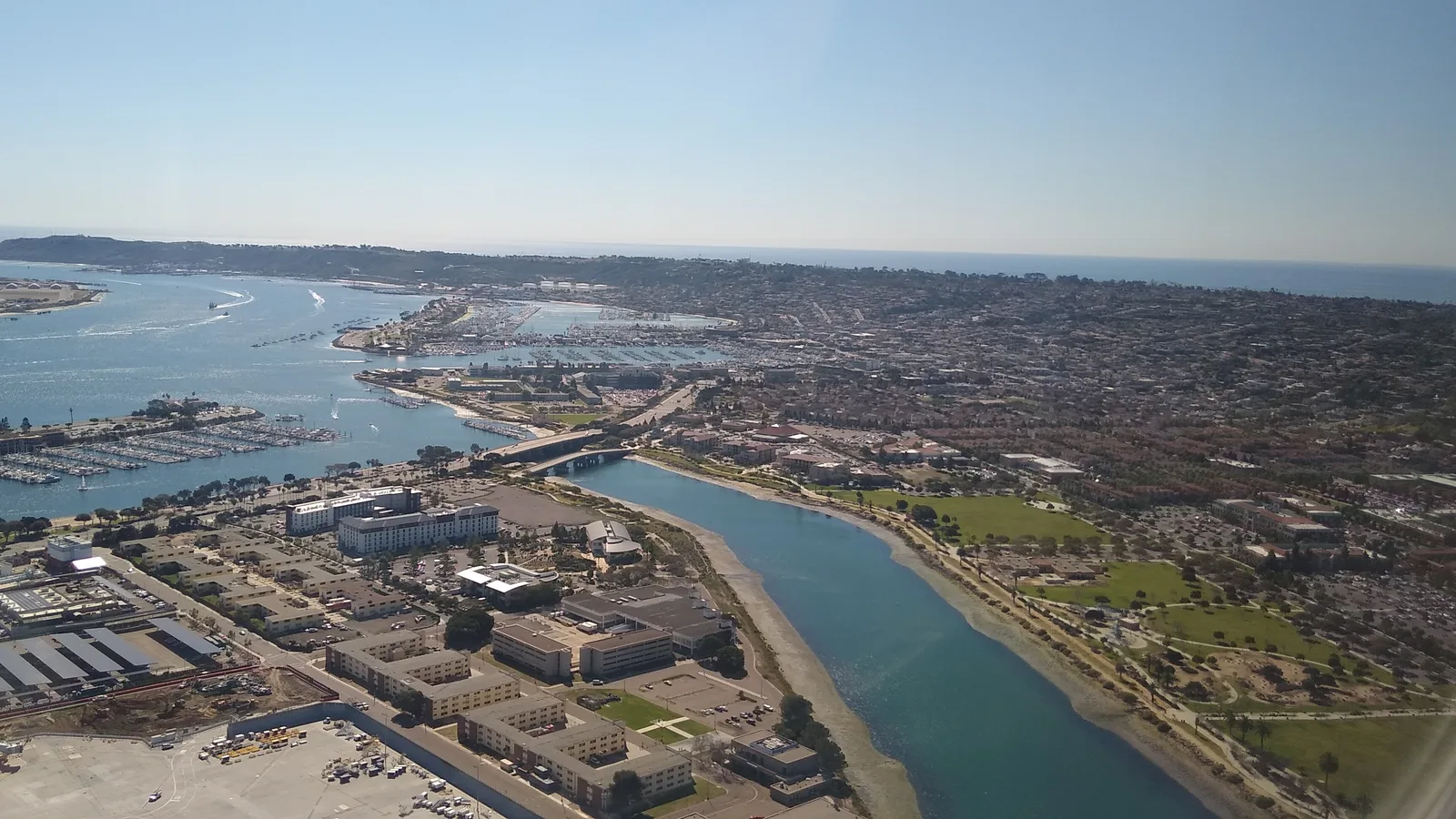
The federal government asked a judge on November 18 to make the City of San Diego pay about $6 million toward the dredging of contaminated sediment from the boat channel at Liberty Station, the former Naval Training Center on San Diego Bay. The city’s lawyer answered that San Diego should pay no more than 12.5% of the cost.
The bench trial before U.S. District Judge Linda Lopez is scheduled to run through November 20, and it decides mainly how the bill is split. Lopez ruled in August 2025 that the city is liable under the federal hazardous-waste cleanup law for releasing contaminants into the channel, and in March 2026 she put the government’s recoverable costs at about $17.1 million.
A third ruling decides who will own the water. On March 30 Lopez found that the city broke a 2000 agreement when it refused to take title to the channel, and she granted the government’s request to make the city complete the transfer. The Navy closed the base in 1997 and still holds the channel today.
The Government Asks for a Third of the Cleanup and the City Offers an Eighth
Justice Department attorney Michael Augustini asked for one-third of the Navy’s cleanup costs, about $5 million, plus about $1 million in enforcement costs, Courthouse News reported from the courtroom. Thomas Vandenburg, an attorney for the city, said San Diego would pay up to 12.5% of the total.
Augustini told the court the government has spent about $16 million on the dredging. “The city has accepted no share of these costs,” he said. The government is willing to bear most of the cost, according to Courthouse News. Its case is that the whole watershed draining into the channel polluted it, the old base included, and that storm drains run by the city carried a large amount of the metals and pesticides.
Much of the opening argument was about DDT, a pesticide banned in the United States in 1972. Augustini said DDT made up 61% of the dredged contaminants and was found in every part of the channel. He showed the court newspaper clippings that described the city misting its neighborhoods with DDT during a 1948 polio outbreak.
Vandenburg called two DDT hotspots in the channel the most important issue of the trial, and he said Navy dumping caused both. “The city should pay 0% for the hotspots,” he said. He told the court the government has no evidence that the city caused them. Augustini said it is unclear how any federal use of the pesticide could have created the hotspots. The report covers opening statements only, so it does not show what evidence either side has for where the hotspots came from.
Earlier Rulings Hold the City Liable and Leave the Split for Trial
Lopez held on August 28, 2025 that San Diego is liable under CERCLA, the Comprehensive Environmental Response, Compensation, and Liability Act, because its storm sewer system and the airport it once owned beside the channel released hazardous substances there. On March 24, 2026 she granted $17,131,016.38 in response costs.
That March 24 order counts at least $15,944,926.65 spent by the Navy through July 31, 2023 and at least $1,186,089.73 spent by the Justice Department through October 31, 2024. The government sued only the city on March 27, 2023 and later added the San Diego Unified Port District and the San Diego County Regional Airport Authority. Those two settled in April 2024 for $2,412,029.89 plus interest, and the court approved that deal on June 18, 2024.
The pretrial order Lopez signed on October 29 says the trial will set the “equitable allocation” of the $17.1 million between the city and the United States, with the earlier settlement payment taken into account. The government told the court it is not seeking 100% of its costs. It is asking for another $207,783.63 in Navy and Justice Department costs that were left out of its earlier motion.
Each side gets eight hours. Lopez will hear no closing arguments, and the two sides will file closing briefs four weeks after the trial transcripts are ready. Both agree the government is owed prejudgment interest, which will be worked out after the trial.
The Navy Dredged 31,057 Cubic Yards and the State Closed the Site
The Navy finished the sediment cleanup on February 24, 2018 and took out about 31,057 cubic yards (23,745 cubic meters) of sediment, according to a San Diego Regional Water Quality Control Board report. The board said the cleanup goals were met for copper, lead, zinc, chlordane and DDT.
The channel is roughly 5,000 feet (1,524 meters) long and about 500 feet (152 meters) wide, widening to about 800 feet (244 meters) at its northern end, according to the government’s complaint. The complaint says no natural stream feeds it, and that its only fresh water comes from storm drains and runoff. The water board counted 33 storm drains that empty into the channel from the old base, the Marine Corps Recruit Depot, San Diego International Airport, and port district and city property.
The board’s assessment found no unacceptable risk to human health, or to birds and mammals, from the sediment before it was dredged. The potential risk it found was to the small animals that live in the bottom mud. The Navy’s 2003 investigation found the contamination was highest in the deeper parts of the channel and lowest along the shoreline, the court’s March 30 order says.
The dredged sediment went to a landfill. The Navy published its completion report in March 2019, and the water board changed the site’s status to closed around that time, the March 30 order says. In April 2021 the board accepted the Navy’s finding that the channel was fit to transfer.
A March Ruling Makes the City Take the Channel It Refused in 2022
Lopez ruled on March 30, 2026 that San Diego breached a May 30, 2000 agreement with the Navy by refusing the two boat channel parcels. She granted specific performance, so the city must complete the transfer. On October 29 she denied the city’s request to appeal immediately.
The 2000 agreement covered seven parcels of the old base, and the Navy promised to clean up the contaminated ones before handing them over. By 2002 the city had every parcel except the two in the channel. The Navy sent the city a deed for one of them on May 16, 2022 and assigned the other to the National Park Service to convey. The city answered that it would accept neither. The Navy sent a notice of default on November 3, 2022. The government’s cost-recovery suit came the following March, and the contract claim was added to it later.
The city argued that the Navy had not finished the cleanup the agreement required, but Lopez found that it had. Her order also records what holding the channel costs the Navy, including about $15,000 a year budgeted for speed control buoys and repairs, and liability for the public’s use of the water. The order says the delay obstructs the Navy base-closure program’s mission to dispose of such property. She wrote that the parcels cannot be reached without an easement from the surrounding landowners, which made it hard for the Navy to find anyone else to take them.
The March 30 order sets no date for the transfer. In denying the immediate appeal, Lopez declined to enter a separate judgment on the contract claim, so the city can appeal it only after a final judgment, which has not been entered.
Hullside’s Take
If the ownership ruling stands, boaters and paddlers on the channel will live with it long after the dredging bill is settled. Since the base closed in 1997 this water has stayed with the Navy, whose base-closure program exists to dispose of it, and which budgets about $15,000 a year for the channel’s speed buoys and repairs. The same court has found that the city released contaminants found in the sediment, and the government’s complaint says storm drains and runoff are the channel’s only fresh water. If the transfer goes through, the city, which runs some of those drains, will own the channel they empty into. I think that is where the responsibility belongs, whatever share of the dredging the city ends up paying. San Diego’s boaters should ask the city now what it plans to spend on the channel if the deed arrives.
Sources: Courthouse News, U.S. District Court for the Southern District of California (United States v. City of San Diego, No. 3:23-cv-00541), San Diego Regional Water Quality Control Board
Hullside uses automated tools to support research and source retrieval. All reporting and editorial perspectives are by Haye Kesteloo. Read our editorial standards or report a correction.
Hullside reports under its editorial standards. See a mistake? Corrections.